INTRODUCTION
This article serves as an essential roadmap for industrial leaders seeking to leverage IIoT and Industry 4.0 to achieve breakthrough performance.
By analyzing Renault’s groundbreaking best practices, data, and lessons learned, it offers actionable strategies that transcend company size or maturity level. While Renault’s milestones may seem out of reach, foundational practices highlighted here are universally applicable. These principles not only drive immediate improvements but also prepare organizations to progress along the maturity curve, ensuring they remain agile and competitive in an increasingly digitized industrial landscape.
Given the depth of the content, the article is structured into four accessible sections, and an appendix part:
- Part 1: Executive Pitch – A concise overview for decision-makers
- Part 2: Detailed metrics – Insights into metrics driving success
- Part 3: Why this article and key lessons learned – The context behind this analysis
- Part 4: Appendix – Renault and Vincent Thavonekham, CEO of FactoVia
PART 1: Executive Pitch
Renault has achieved what many industrial leaders aspire to, turning traditional factories into cutting-edge Industry 4.0 ecosystems. By connecting over 15,000 devices across 23 sites and leveraging actionable data, the company saves €320 million annually with improvements of its environmental impacts. This success is underpinned by an advanced IT/OT convergence strategy, modular architectures, and rigorous ROI-driven implementation of digital tools and use cases. Renault’s journey proves that a well-executed digital transformation delivers transformative outcomes.
PART 2: Detailed metrics
Renault’s performance metrics provide a blueprint for achieving operational excellence:
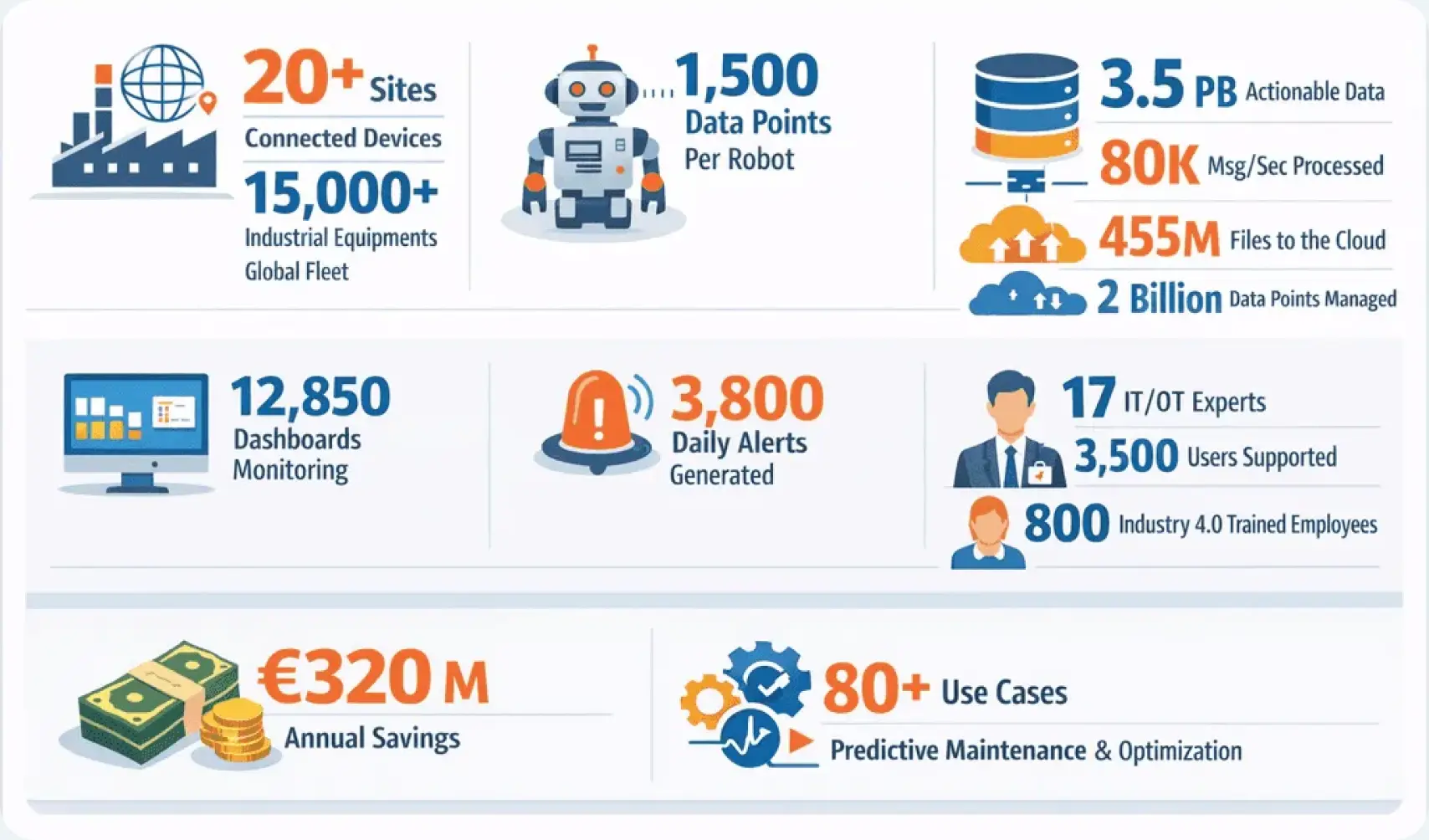
- Over 15,000 industrial pieces of equipment across global sites.
- A robot returns 1,500 data points
Data Management
- 3.5 petabytes of actionable data.
- ~80,000 messages processed per second.
- 455 million files published to the cloud.
- Over 2 billion data points securely managed to date.
Dashboards and Alerts
- 12,850 dashboards monitoring operations.
- 3,800 alerts generated daily to ensure system integrity.
Team Structure
- Lean IT/OT team of 17 experts supporting 3,500 users.
- 800 employees trained specifically for Industry 4.0 workflows.
Savings
- €320 million annually through efficiency gains and use-case optimization.
Use Cases
- 80+ standard Use Cases (+ specific ones), ranging from predictive maintenance to process optimization.
- ROI-driven triage ensures high-priority projects deliver maximum impact.
PART 3: Why this article and key lessons learned
A) Why this article?
During an inspiring live session with IIoT experts Walker Reynolds and Zack Scriven, from 4.0 Solutions, I was amazed by the precise insights that Walker has about the Renault Group’s digital transformation, despite it is a project located on the other side of the planet, in France!
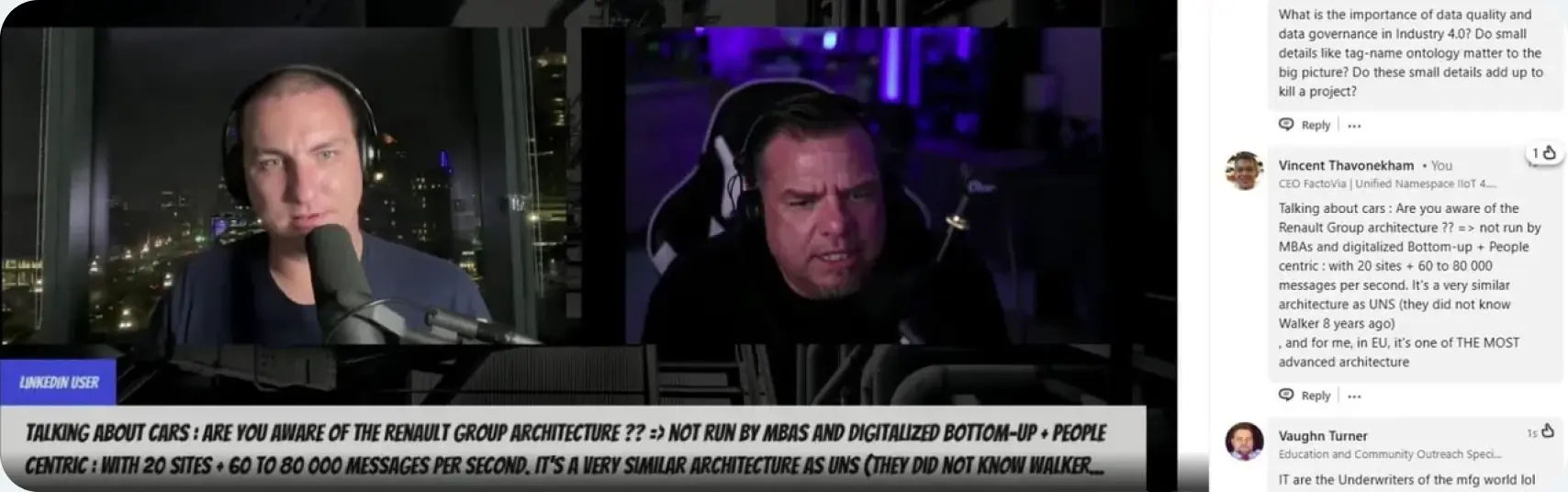
Being familiar of this initiatives for the last 7 years, thanks to Thierry Daneau (*), this article dive deeper and share lessons from one of the most advanced industrial ecosystems. Regarding the architecture and Digital Transformation of Renault, “It’s Rock solid”, says Walker.
(*) Thierry is the Renault worldwide 4.0 expert, and transformation champion behind the scene. FactoVia was lucky to have Thierry as godfather.
B) Lessons learned
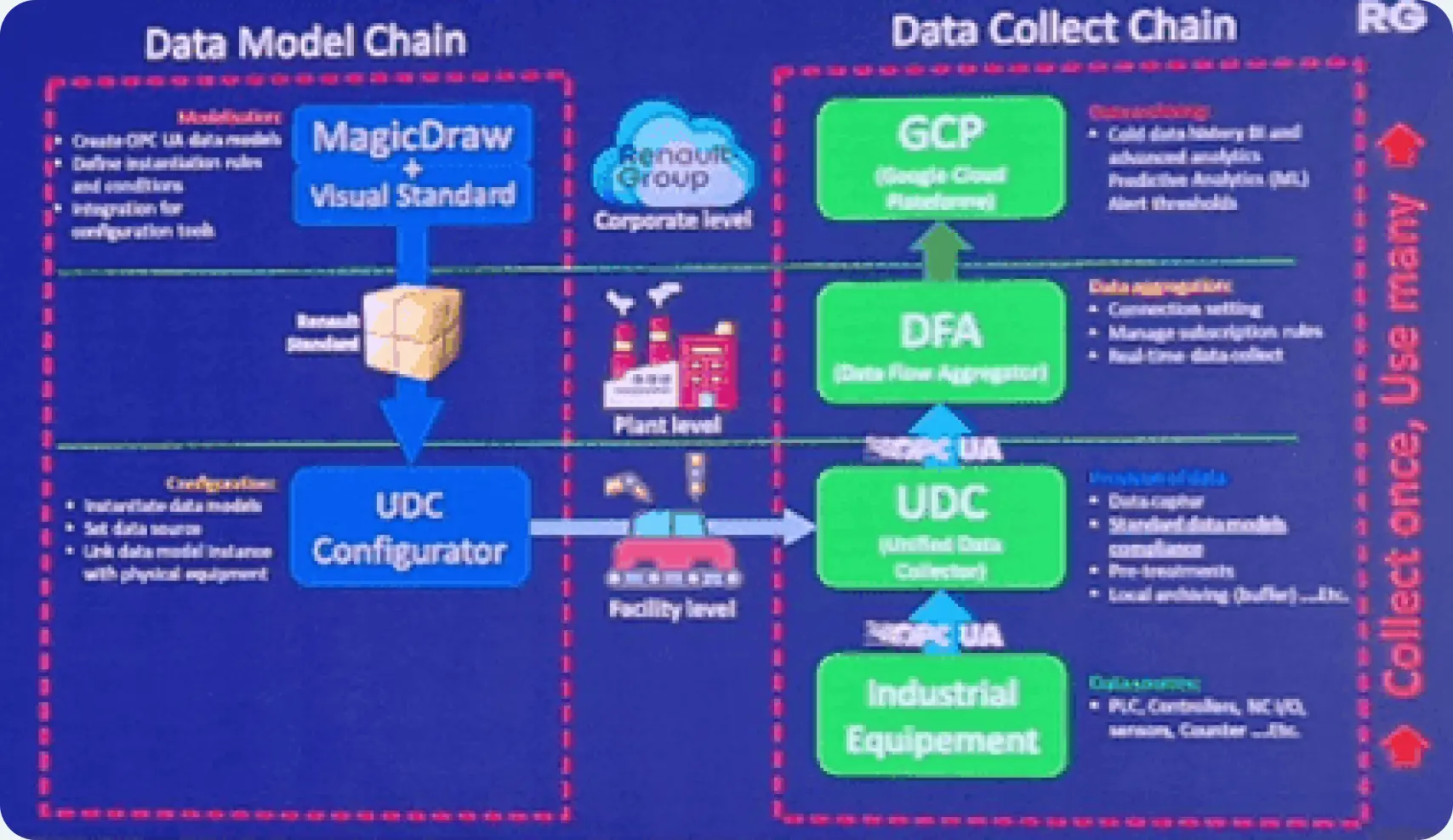
Renault’s transformation began over a decade ago, spearheaded by Thierry Daneau, their IIoT visionary. By simplifying ISA-95 frameworks into three actionable levels and leveraging Google Cloud and MQTT technologies, Renault created a scalable and modular architecture. This architecture supports:
- Corporate Level: Centralized data management with Central Nifi in the Cloud, Google BigQuery (structured data) and Google Buckets (flat files : jpg, bmp, csv, txt, …).
- Plan Level: Data Flow aggregator (DFA) Use-case aggregation using local NiFi instances, and both an OPC UA server and an MQTT Broker, to deploy Local Use Cases.
- Facility Level: Unified Data Collectors (UDCs) gather and format all data to OPC UA for seamless transmission.
Renault’s mantra, “Collect once, use many”, guided their seven-year transformation, ensuring every step added value.
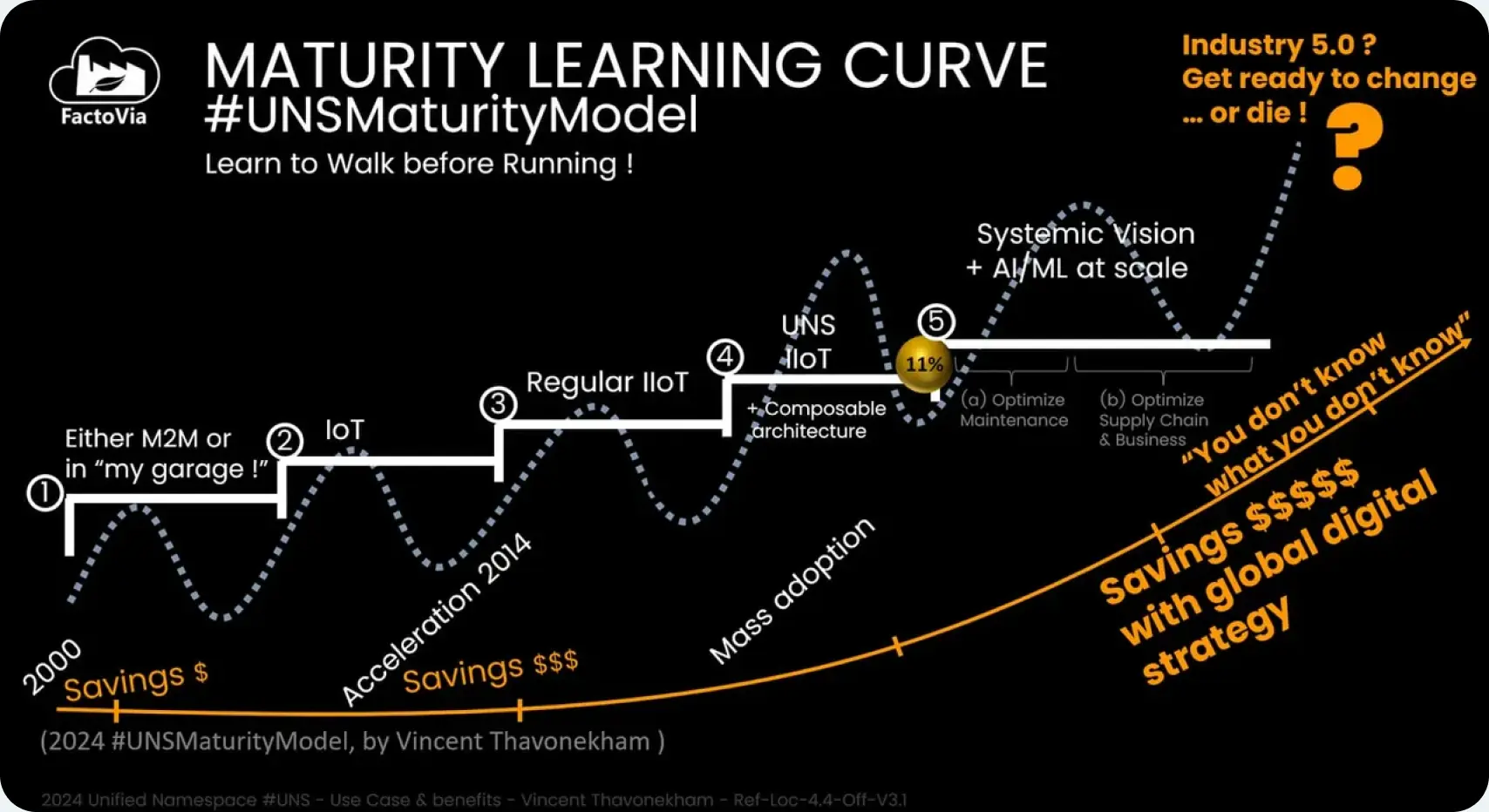
- Adopt Unified Namespace (UNS): Renault don’t exactly call their architecture UNS, because they started way before UNS was democratized by it’s inventor Walker Reynolds. However, Renault converged into a similar architecture (not exactly the same ; see appendices). Renault’s success illustrates the critical role of UNS in bridging silos, and move to Level 5 of the Maturity model.
- Invest in Change Management: Beyond technology, aligning teams with a shared strategic vision accelerates adoption. From our experience, either you have a Thierry-like champion internally, or recruit one, or asks FactoVia for external senior experts.
- Prioritize ROI-Driven Use Cases: Tackle high-impact Use Cases and scalable projects to secure long-term value. And only then, think about the #Industry40 tools to accelerate (IA, Computer Vision, Digital Twin, …). And not the other way round ! which is guaranteed to lead to failure. Don’t implement randomly everything ! Triage based on the ROI. Priority gains = KPI impact x difficulty versus cost x number of production line problems.
- Feedback on OPC UA : Pros and Cons OPC UA
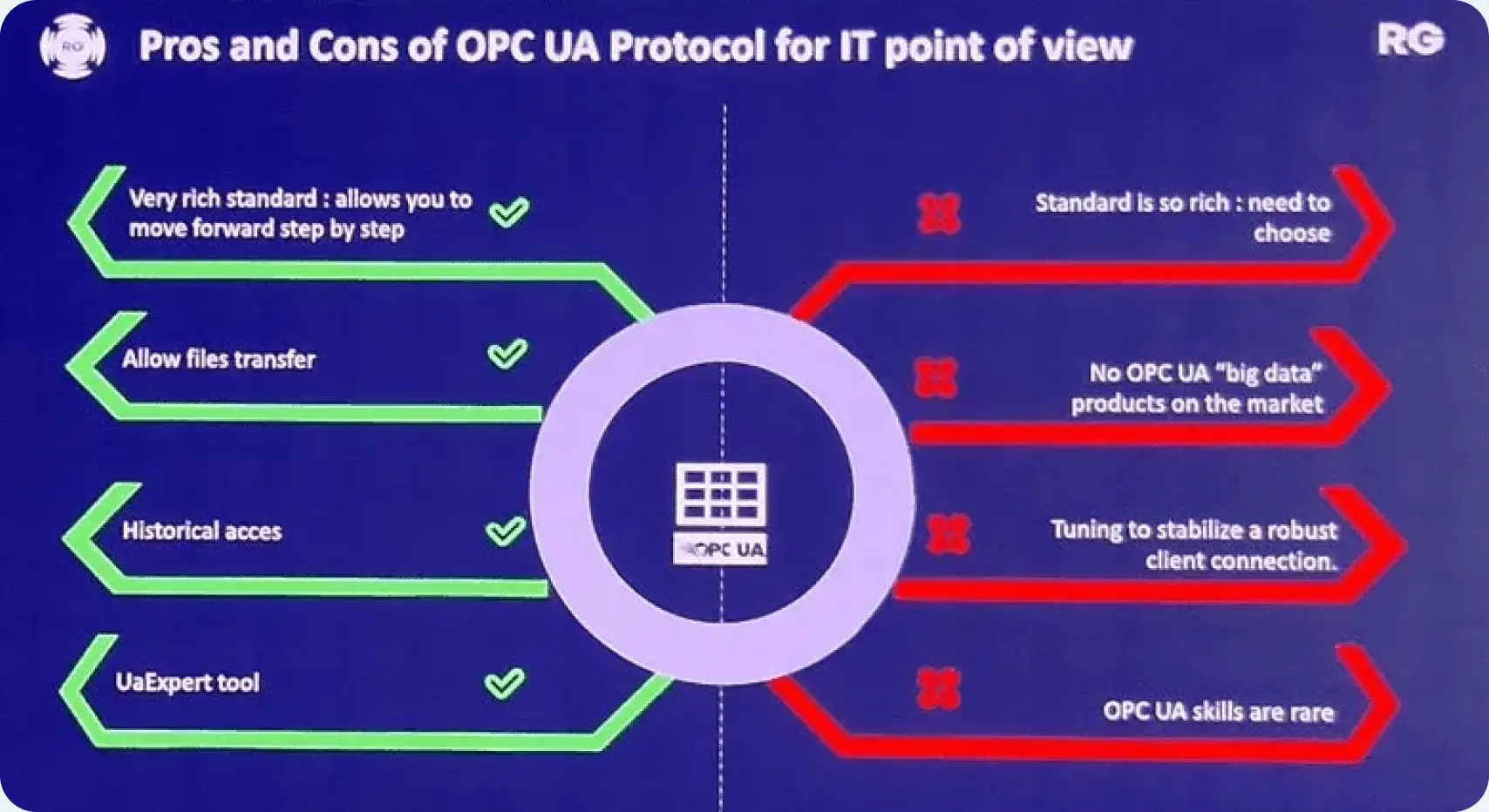
Cons: very time consuming
Cons: Not many experts.
Process: OPC UA Data modeling, that was done in 3 different phases:
- Get the list of variable and get dictionary variable names
- Start analyzing and modeling in objects with UML, then a conversion into OPC UA (semi-automated configuration tools)
- Collaborative work + model conformity check + automation of sanity check controls
- This transformation wasn’t just technical: it required a mindset shift. Renault reached Level 5 maturity on the #UNSMaturityModel, driving systemic value through advanced use-case triage and seamless IT/OT convergence.
PART 4: APPENDIX
History of Vincent and Renault
Vincent’s collaboration with Renault began over a decade ago while working under NDA on key projects. During an OPC UA presentation, he met Thierry Daneau, Renault’s IIoT transformation expert. Their deep discussions on IIoT architectures continued well beyond the conference room. Thierry, renowned across Europe for his expertise, played a pivotal role in Renault-Nissan-Mitsubishi’s IIoT journey. As Vincent founded FactoVia, he invited Thierry to serve as FactoVia’s godfather to ensure solid foundation. Over time, they continued to meet at industry events, sharing insights and experiences, including memorable moments with HiveMQ, world expert and leader in mqtt.